Published August 31, 2026 · 7 min read · By Pavel Rataj & Honza Vojtko
Signs your marriage is in crisis - and what they actually mean
Most lists of warning signs get one thing wrong: they focus on the loud signals and miss the quiet ones. After twenty years with couples in crisis, we would sort the signs differently - by what they tell you about where the relationship actually is.

If you are searching for signs, something in you already knows. People do not look up articles like this one out of idle curiosity; they look them up at midnight, after another evening that felt wrong in a way that is hard to name. So let us treat your unease as the first piece of data - not proof of anything yet, but a reason to look carefully. What follows is not a checklist to score yourself against. It is an attempt to explain what different signals tend to mean, because two marriages can show the same symptom for opposite reasons.
The loud signs: fighting that goes in circles
Frequent conflict is what most people picture when they hear 'marriage in crisis,' and it is genuinely worth attention - but not for the reason you might think. The amount of fighting matters less than its shape. Couples who argue about many different things, and sometimes actually resolve one, are often in ordinary trouble. The concerning pattern is the circular fight: the same argument, with the same script, arriving at the same dead end - whether the topic is money, in-laws, or who said what in which tone. When you could both recite the other's lines in advance, the fight is no longer about its subject. It has become the surface of something underneath: usually a question one or both of you have stopped asking out loud. Do I matter to you? Are you still with me?
One more thing about loud marriages, and it may be a relief to hear: heat is not the worst sign. People fight where they still hope to be heard. It is an exhausting form of hope, but it is hope.
The quiet signs: when a marriage stops fighting
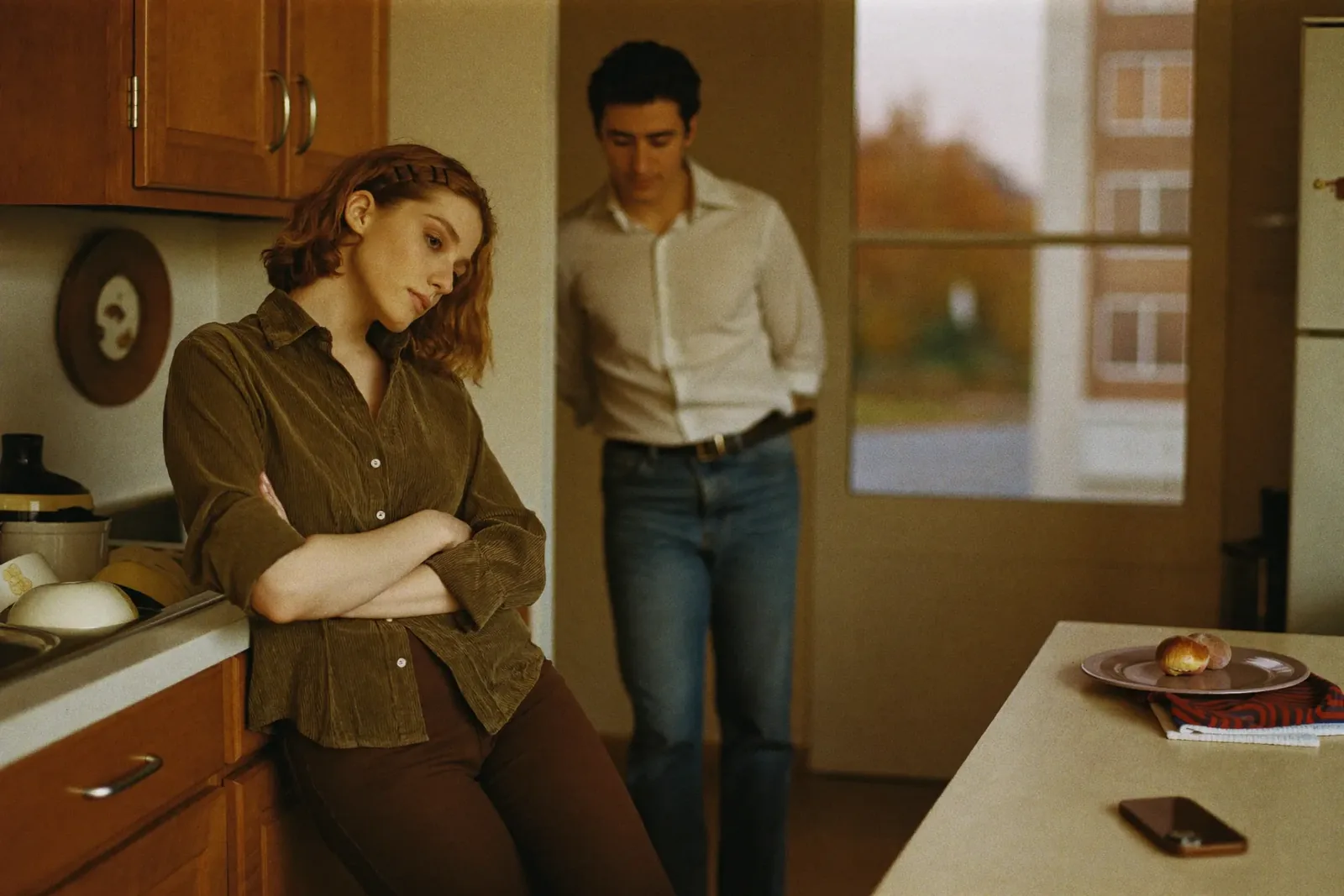
The signals we take most seriously in the therapy room are the ones that make no noise. The fights stop - not because anything was resolved, but because both of you quietly concluded it is not worth it. Conversations narrow down to logistics: the children, the schedule, the leaking tap. You become excellent housemates. Evenings are peaceful in a way that should feel good and somehow does not. If a friend asked, you would say things are fine - and you would notice a small hesitation before you said it.
Why do we weigh this so heavily? Because silence in a marriage is usually not emptiness. It is protection. Each partner has learned that reaching out costs too much - it leads to a fight, or to disappointment, or to that look - and so each one, sensibly, stops reaching. The trouble is that the same wall that keeps out the pain keeps out everything else. A marriage can survive years like this. The question is what is quietly starving behind the wall.
The sign almost nobody names: losing the shared future
There is one signal we would put above nearly all others, and it rarely appears on the lists. It is what happens when you try to imagine the two of you five years from now. In a living relationship - even a stormy one - that picture exists. It may be vague or postponed, but it is there: a place you might live, a trip, an ordinary imagined morning. In a deepening crisis, the shared future is often the first thing to go dark, long before anyone says the word divorce. If you can picture your own future but the marriage appears in it only as a logistical fact, or if the picture simply refuses to form, take that seriously. Not as a verdict - as a signal that the relationship has stopped being a place where your hope lives.
What the signs do not tell you
Here is where we part ways with most of what you will read online. The signs tell you that something is wrong. They do not tell you what, and they do not tell you how it ends. We have sat with couples who arrived barely speaking, every box on every warning list ticked, who found their way back to something more honest than what they had before the crisis. And we have seen relationships that looked mildly troubled dissolve within a year. The difference was almost never how bad the symptoms looked. It was whether the two people could stop treating each other as the problem long enough to see the pattern they were both caught in.
So if you recognized yourself in this article, the useful next step is probably not a bigger diagnosis. It is orientation: understanding how your particular marriage arrived here, what keeps the pattern turning, and where it can be interrupted. A crisis is not asking you to try harder. It is asking you to understand what you are standing in - and that, unlike the outcome, is something you can begin alone, tonight.
Questions people ask
- Is constant fighting a sign my marriage is over?
- On its own, no. Couples fight where they still hope to be heard. What matters more is the shape of the conflict: fights that circle the same script to the same dead end suggest the real question underneath is not being asked. And a marriage that stops fighting without resolving anything may be in deeper trouble than a loud one.
- We never fight. Can our marriage still be in crisis?
- Yes - and this is one of the most overlooked situations. When conversations shrink to logistics and peace comes from distance rather than from resolution, the silence is usually protecting both partners from a reaching-out that has come to cost too much. Comfortable coexistence and quiet crisis can look identical from the outside; the difference is what happens when one of you genuinely tries to get close.
- How do I know if it's a rough patch or a real crisis?
- A rough patch has edges - it is tied to circumstances, and closeness returns when the pressure lifts. A crisis has momentum: attempts to fix things reliably fail or make them worse, distance keeps growing regardless of circumstances, and the shared future starts to go dark. If your repair attempts have stopped working, treat it as a crisis - it responds to understanding, not to waiting.
Keep reading
Why you keep having the same fight - and why winning it never helps
Every couple has one. The fight that has been rehearsed so many times you could play each other's parts. The topic…

How to save your marriage when you're the only one trying
It may be the loneliest position in a relationship: you can see the marriage slipping, you are doing everything you…